One of the most important thing’s to study in mathematics is the idea of continuity, and it has a lot o formulations, some tough than others. The first time you encounter with this concept is when you are studying a course on calculus, and we are interesting of the properties of certain functions to be continuos on a given interval \(I\), meaning that it sends close point’s to close points in the following sense.
Definition. A function \(f:I\subseteq\RR\mapsto J\subseteq\RR \), is said to be a continuos function on \(x_{0}\in I\), if for every \(\epsilon>0 \) there is a \(\delta>0 \) such that
\begin{align}\abs{x-x_{0}}<\epsilon\Rightarrow\abs{f(x)-f(x_{0})}<\delta,&&\forall x\in I.\end{align}
A function which is continuos on all their domain is called a continuos function.
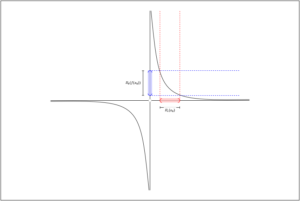
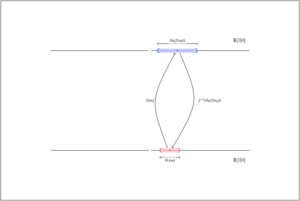
The most common misconception on the idea of continuity of functions is the idea that a function \(f:A\subseteq\RR\mapsto B\subseteq\RR \), is continuos if you cad draw it without lifting the pencil. The issue whit this conception of continuity is that continuity is a property of a function and their domain; in particular, the function \(f:\RR/\{0\}\mapsto\RR/\{0\}\) define as
\begin{align}\label{uno en x} f(x)=\frac{1}{x}, \end{align}
is a continuos function on all their domain, but you cannot draw it without lifting the pencil. A better way to think on continuity, is that a function is continuos if it deforms its domain into their codomain without braking it, just tearing it, merely stretching or shrinking it. Under this idea, the function define as \eqref{uno en x} is a continuos function, because it deforms each of the two branches of the domain (the real line without the cero) into another copy of the domain without breaking it, because it was break at the beginning.
The study of continuity in \(\RR^{n} \) is part of a subject called real analysis, and we can generalized by studying the so called metric spaces, which are set’s of objects equipped with a notion of distance between elements. Given a distance between elements, we can define the open ball’s and then we can talk about continuity.
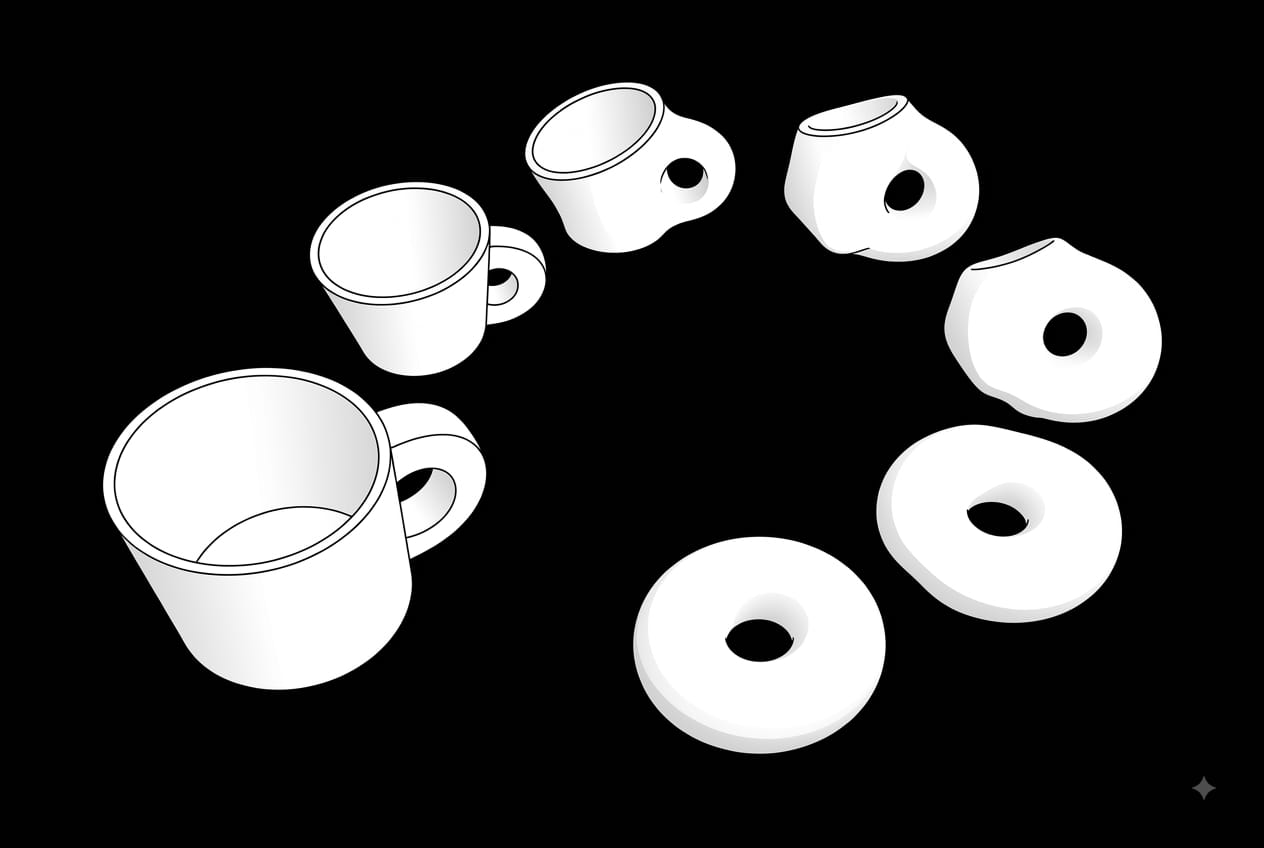
On topology, we generalize this notion without the needed of a metric or distance; in a nutshells we can say that a topology in a set is just a way to say what subsets are open (equivalent, by the complement, what subsets are close) in a consistent way, such that in a particular case we regain the properties of metric spaces.
Applications
Topology has been one of the most successful tools for the study of theoretical physics, in particular, is one of the basis for the understanding of differential geometry, which is needed for the study of the Einstein’s theory of general relativity. On this frame we model the space-time —which the space made by all the posible places and times— by a differential manifold, and we model gravity as the curvature of this manifold.
Formaly, we said that a manifold \(\MM\) is a topological space \((X,\tau)\) which Hausdorff, second countable and is locally homeomorphic to \(\RR^{n}\) . As you can see, the formal definition of a manifold is nothing but topological.
Given a topological manifold, we can define tensor fields on it, in particular, we can define skew-symmetric covariant tensors, which are called differential forms. The space of all differential forms define on a manifold \(\MM\) of rank \(k\) is denoted as \(\Lambda^{k}(\MM\) and give as a vectorial space at every point (in the topological jargon we say that this is a vector bundle). We can also define a new operator \(d:\Lambda^{k}(\MM)\mapsto\Lambda^{k+1}(\MM\) such that it satisfies, among others, the following propertiy: \(d\circ d\equiv 0\); we call this operator the exterior derivative. Even this operator looks unfamiliar, actually it generalize the gradient, curls and divergence; furthermore, it is true that
\begin{align}\int_{\MM}d\omega = \int_{\partial\MM}\omega , && \forall \omega\in\Lambda^{k}(\MM), \end{align}
where \(\MM \) is a compact smooth manifold and \(\partial\MM\) is their border. This result is called generalized stoke’s theorem (GST), and tell us that in some sense, the information of the integral on a manifold is contained on their border by the exterior derivative.
We say that a \(k\)-form \(\omega\) is exact if we can find a \(k-1\)-form \(\alpha\) such that \(\alpha=d\omega\), and we say that it is close if is true that \(d\omega=0\). By construction, every exact form is exact, but not all the closed forms are exact, actually, we can say when the oposite is true by studying the topological properties on the manifold in which they are define.
The algebraic topology is the study of relate algebraic objects (such as groups) with topological spaces, and study the algebraic properties by studying the topological, and vice versa. The first example of this is the so called fundamental group, which is the group made by the equivalence class of curves that can be deformed into another by a continuos deformation.
One of the most astonishing applications of topology, in particular algebraic topology, is the so called topological materials. In a periodic materials such as crystals, we dont need to know what hapend in all the space, by the periodicity, and this also happens on the momentum space. Since the cristal is periodic, the potencial due to the other lattice points is the same when you travel a distance of \(a^{\mu}\) units in the direction given by the \(\vec{b}_{\mu}\) lattice vector. Then all the information about the momentum \(\vec{k}\) is reducted to a small part of the total momentum space. Furthermore we can identify points of the momentum zone \(\vec{k}\) whit a vector \(\vec{k}+\sum_{\mu}n^{\mu}\vec{G}_{\mu}\).
The last one defines a equivalence relation in points of \(\RR^{n}\) and it has been well studied in topology; this construction is know as quotient space, and in this particular example give us a torus. Furthermore, we can asigne to every point a vectorial space define by the levels of energy and the Hamiltonian (wich depends on the wave vector) and this is an example of a fibber bundle. Fibber bundles are one of the most important objects in algebraic topology and algebraic geometry.
Leave a Reply